For many people, the word “token” immediately brings Bitcoin, cryptocurrency or online trading to mind. That connection is understandable, but it captures only one part of a much bigger transformation.
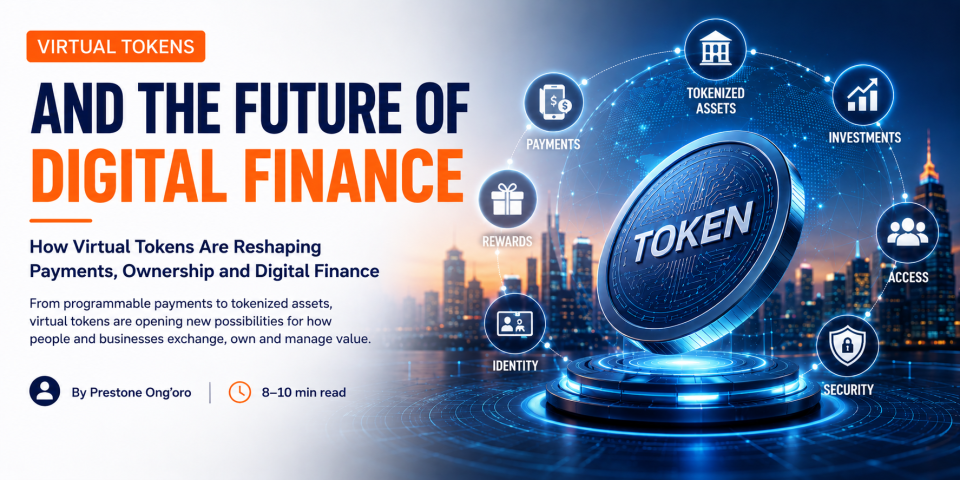
A virtual token can represent money, ownership, access, identity, rewards or a claim on a real-world asset. It might represent a payment balance, a portion of a building, a concert ticket, a loyalty point, a digital certificate or the right to use a particular service.
In simple terms, a virtual token is a digital representation of value or rights that can be created, transferred and verified electronically.
The real importance of tokens is therefore not that they are digital coins. It is that they can make value programmable, transferable and easier to manage.
This capability is beginning to influence how payments are made, how investments are accessed, how ownership is recorded and how businesses design digital services. Institutions such as the International Monetary Fund and the Bank for International Settlements increasingly describe tokenization as more than a software upgrade: it could change parts of the structure through which money and financial assets move.
What exactly is tokenization?
Tokenization is the process of creating a digital representation of an asset, right or claim on a programmable platform.
Consider a commercial building worth millions of shillings. Traditionally, investing in that building might require substantial capital, legal paperwork and several intermediaries. Through tokenization, ownership could potentially be divided into smaller digital units. Instead of buying the entire property, an investor could purchase tokens representing a small share of it.
The same principle could be applied to bonds, commodities, investment funds, invoices, intellectual property or renewable-energy projects.
However, tokenization does not automatically make an asset safe or valuable. A token is only as trustworthy as the asset behind it, the organization issuing it, the legal rights attached to it and the technology protecting it.
This distinction is important: the token is the digital representation, not necessarily the asset itself.
Virtual tokens are bigger than cryptocurrency
Cryptocurrencies are one category of virtual tokens, but the wider token economy includes several different models.
Payment tokens — Designed to transfer value between people, businesses or digital platforms. Some fluctuate in price, while others—commonly called stablecoins—attempt to maintain a stable value by linking themselves to a conventional currency or reserve asset.
Utility tokens — Provide access to a product, platform or service. A digital platform might issue tokens that customers can use to access premium features, pay transaction fees or participate in a digital community.
Asset-backed tokens — Represent a claim on an underlying asset such as property, gold, company shares, bonds or investment funds. Their purpose is to make ownership easier to divide, transfer and track.
Reward and loyalty tokens — Organizations can use tokens to represent customer rewards. Unlike traditional points that work within only one system, future token-based rewards could potentially be transferred between participating platforms or exchanged for different services.
Identity and credential tokens — Represent verified information rather than money. A token could confirm that someone holds a qualification, has completed a compliance check or is authorized to access a particular system—without unnecessarily exposing all their personal information.
Not all these tokens need to operate on a public blockchain. Some may use private distributed ledgers, controlled financial networks or other secure digital infrastructure. What matters is whether the system provides trustworthy records, clear ownership and reliable rules for transferring value.
Why virtual tokens could reshape digital finance
The current financial system is already digital. We use mobile banking, card payments, online wallets and electronic trading platforms every day.
Tokenization introduces something different: it can combine the record of an asset with the rules governing how that asset is used.
A traditional digital payment may pass through several separate systems for authorization, messaging, clearing, settlement and reconciliation. On a programmable tokenized platform, some of these activities can be combined and executed automatically. The Bank for International Settlements describes this as the ability to integrate messaging, reconciliation and asset transfer into one operation. The IMF similarly notes that tokenized systems can allow the execution of a transaction, transfer of ownership and movement of payment to happen simultaneously.
That creates several possibilities.
1. Faster and more efficient payments
Cross-border payments can involve several banks, currencies, compliance checks and operating schedules. Each additional step may introduce delays and costs. Tokenized payment infrastructure could allow instructions, verification and settlement to happen through a more connected process — improving cash flow for businesses and making transfers more convenient for individuals.
2. Programmable financial services
A token can contain or interact with rules written in software. Imagine an agricultural insurance product connected to reliable weather information: when verified rainfall levels fall below an agreed threshold, a smart contract could automatically initiate a payment to an eligible farmer. A business loan could calculate interest automatically, monitor repayment conditions and release collateral once complete. This is often described as programmable finance — reducing delays, disputes and repetitive administrative work.
3. Fractional ownership
Tokenization can divide a valuable asset into smaller units, allowing more people to participate in investments such as real estate, infrastructure, private markets or renewable-energy projects. The World Economic Forum identifies fractional ownership as one of tokenization’s most promising features because it may lower entry barriers and expand access to financial markets, particularly in emerging economies. This must still be supported by clear legal rights — a token referring to a building is meaningless unless ownership and income rights are legally recognized.
4. Financial markets that operate continuously
Tokenized platforms can operate around the clock, improving access and liquidity — but also creating new responsibilities around cybersecurity monitoring, customer support and emergency controls.
5. New business models
Tokens can allow organizations to build digital ecosystems: mobility credits across transport services, energy-linked tokens, or content-platform tokens offering access and revenue participation. They can also support machine-to-machine payments — an EV automatically paying a charging station, or an IoT device purchasing extra computing capacity. These ideas become more practical when connected with AI, cloud computing, digital identity and secure APIs.
The technologies driving the change
- Blockchain and distributed ledgers — a shared record authorized participants can examine and update, improving traceability.
- Smart contracts — programs that execute actions automatically when conditions are met.
- Artificial intelligence — helps detect unusual transactions, assess risk and identify fraud, though decisions must remain explainable and accountable.
- Digital identity — establishes who is authorized to hold or transfer a token; essential for consumer protection and compliance.
- Internet of Things — provides real-world data (location, energy production, delivery status) to tokenized systems. A smart contract can execute perfectly and still produce the wrong result if it receives inaccurate or manipulated data.
The risks we should not ignore
Virtual tokens can be stolen through compromised accounts, fake platforms or security vulnerabilities. Smart contracts may contain software errors. Criminals can create tokens linked to assets that don’t exist.
Privacy is another concern — a permanent transaction record shouldn’t make financial activity unnecessarily visible to employers, businesses, governments or the public. Interoperability is a challenge too: a token that works on one platform may not work on another, risking fragmentation rather than connection.
Legal uncertainty is significant. Token holders must know what they actually own, which jurisdiction applies, and what happens if an issuer fails.
The IMF warns that tokenization may remove some of the time buffers institutions currently use to detect errors or respond to market stress — meaning automated failures could spread faster. The World Economic Forum similarly identifies cybersecurity, privacy, liquidity, legal clarity and interoperability as major barriers to adoption.
Building a responsible token economy
The future of virtual tokens should not be driven by hype or the assumption that everything belongs on a blockchain. Responsible adoption begins with one practical question: What real problem does the token solve?
A credible token system should have:
- A clearly defined purpose
- A trustworthy issuer or governance structure
- Transparent information about the value or asset behind it
- Clear legal rights for token holders
- Strong cybersecurity and independent testing
- Protection against fraud, manipulation and unauthorized access
- Privacy controls appropriate to the information involved
- Compatibility with existing financial and regulatory systems
- Simple recovery procedures for lost devices or credentials
- Accessible user experiences that don’t require technical expertise
Most importantly, tokenized finance must remain understandable to ordinary users — people shouldn’t need to understand blockchains or cryptographic keys to make a safe payment, just as they don’t need to understand telecom infrastructure to make a phone call.
Will tokens replace banks and traditional money?
Probably not in the way often suggested. Banks, central banks and regulators perform functions far beyond maintaining transaction records — providing credit, protecting deposits, managing liquidity and enforcing financial rules.
Tokenization is more likely to change how these institutions operate than eliminate them entirely. The IMF’s analysis argues that banks will change rather than disappear as tokenized deposits, lending and securities alter how institutions manage payments, liquidity and risk.
The future financial system will probably be hybrid — traditional accounts, mobile money, tokenized deposits and regulated digital assets operating together. The most successful services may be those that hide the technical complexity and simply deliver faster, safer, more affordable experiences.
Looking ahead
Virtual tokens have the potential to reshape digital finance because they allow value, ownership and rules to exist within the same digital environment. They could make payments faster, investments more accessible and financial agreements easier to automate.
But technology alone will not create trust. Trust will come from strong security, understandable products, responsible regulation, reliable institutions and clear protections for users.
Virtual tokens are not simply a new form of digital money. They are becoming a new way of representing and exchanging value — and that could make them one of the foundations of the next generation of digital finance.
Take action
As virtual tokens continue to evolve, businesses, policymakers and technology leaders must look beyond the hype and focus on practical, secure and inclusive applications. Explore more insights on financial technology, artificial intelligence and digital innovation from Favitech.