

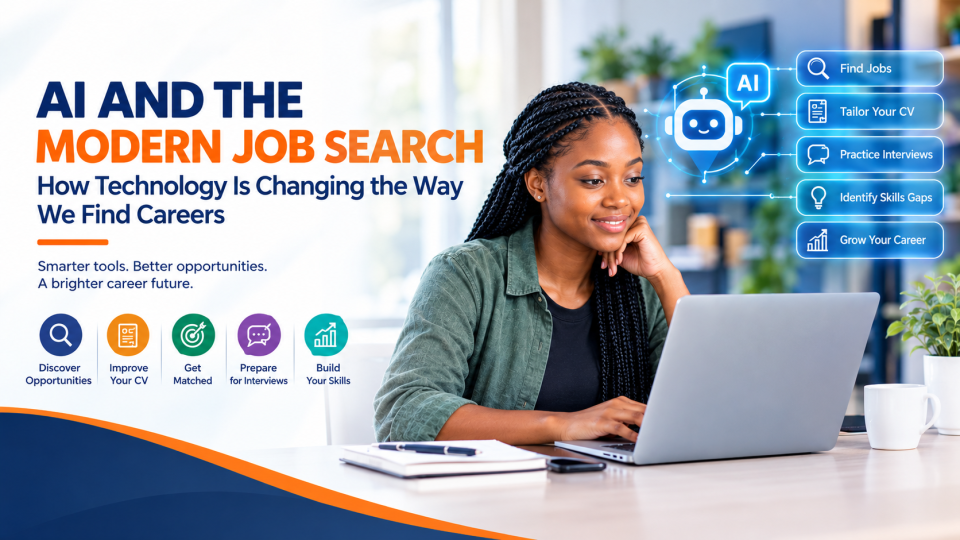
The job search has changed significantly in recent years. Gone are the days when job seekers depended entirely on newspaper advertisements, physical applications, or manually browsing hundreds of vacancies every day.
Today, Artificial Intelligence (AI) is becoming an important tool in the career journey.
From discovering relevant job opportunities to improving CVs, preparing for interviews, and identifying skills gaps, AI-powered tools are helping job seekers approach the employment market more strategically.
But AI is not replacing the job seeker. Instead, it is becoming a career assistant—helping people work smarter, research opportunities faster, and present their skills more effectively.
The Rise of AI in Career Searching
The modern employment market can be overwhelming. A single job platform can contain thousands of vacancies across different industries, locations, experience levels, and skill requirements.
Manually going through every opportunity can take hours.
AI-powered job-search tools can analyze job descriptions, keywords, qualifications, experience requirements, and other information to help candidates identify opportunities that may be relevant to their profiles.
For example, a graduate looking for an entry-level technology position can use AI tools to identify vacancies related to:
- Software development
- IT support
- Cybersecurity
- Data analysis
- Digital marketing
- Web development
- Cloud computing
- Technical support
Instead of searching broadly for “jobs,” candidates can use technology to develop a more focused career-search strategy.
AI Can Help You Improve Your CV
One of the biggest challenges for job seekers is creating a CV that clearly communicates their skills and experience.
AI tools can help candidates review their CVs against specific job descriptions and identify areas that may need improvement.
For example, if a company is looking for a candidate with experience in:
“Customer relationship management, digital marketing, data analysis and Microsoft Excel,”
AI can help a job seeker identify whether those skills are clearly represented in their CV.
It can also help with:
- Improving the structure of a CV
- Identifying missing keywords
- Rewriting unclear descriptions
- Highlighting relevant achievements
- Creating different CV versions for different roles
- Improving professional summaries
However, candidates should avoid allowing AI to completely write their professional story.
Your CV should represent your real experience, qualifications, achievements and skills.
AI should improve the presentation—not manufacture experience.
AI and Job Matching
Another important development is AI-powered job matching.
Traditional job searches often depend heavily on keywords. Modern systems can analyze more than just job titles.
AI can consider factors such as:
Skills + Experience + Industry + Location + Education + Job Requirements
This can help candidates discover positions they might otherwise overlook.
For example, someone searching for “IT Support Technician” might also be qualified for roles advertised as:
- Technical Support Specialist
- IT Service Desk Analyst
- Helpdesk Technician
- Systems Support Officer
- ICT Support Assistant
Understanding these relationships can significantly broaden a candidate’s search.
AI Can Help With Cover Letters
Writing a new cover letter for every application can be time-consuming.
AI can help candidates create a customized starting point based on a job description.
Instead of submitting the same generic message to every employer, candidates can use AI to identify the organization’s requirements and create a more relevant application.
But there is an important difference between personalization and automation.
A candidate should review the generated content and make sure it accurately reflects their experience.
Employers increasingly receive large numbers of applications, and generic AI-generated applications can become easy to recognize.
Preparing for Interviews With AI
AI is also becoming useful after the application has been submitted.
Candidates can use AI tools to simulate interviews.
For example, an applicant applying for a Software Testing Engineer position could ask an AI assistant to conduct a mock interview covering:
- Software testing fundamentals
- Manual testing
- Test cases
- Bug reporting
- Agile methodology
- API testing
- SQL
- Behavioral questions
The candidate can then practice answering the questions and receive feedback on clarity, structure and completeness.
This turns AI into something more than a job-search tool.
It becomes a virtual interview preparation partner.
AI Can Help Identify Skills Gaps
Technology is changing rapidly, and employers’ requirements are changing with it.
A job seeker may discover that many positions in their preferred career require skills they currently don’t have.
For example, someone interested in digital marketing may find that employers increasingly request knowledge of:
- Search Engine Optimization (SEO)
- Google Analytics
- Social media advertising
- Content strategy
- Email marketing
- Marketing automation
- AI-assisted content creation
AI can help candidates compare their current skills against market requirements and identify areas where additional learning could improve their competitiveness.
This creates a more proactive approach to career development:
Don’t simply search for jobs. Search for the skills that the job market is demanding.
The Rise of the AI-Assisted Job Seeker
The modern job seeker is increasingly becoming an AI-assisted professional.
Instead of spending several hours performing repetitive tasks, candidates can use AI to accelerate parts of the process:
Discover → Analyze → Customize → Prepare → Apply → Learn
For example:
- Discover relevant vacancies.
- Analyze job descriptions and requirements.
- Customize your CV and application.
- Prepare for interviews.
- Apply with accurate information.
- Learn from unsuccessful applications and improve.
This can make the job-search process more structured and efficient.
But There Is a Risk: Over-Reliance on AI
Despite its benefits, AI should not become a substitute for human judgment.
AI systems can produce inaccurate information, misunderstand job requirements, or generate generic applications.
Job seekers should therefore verify important information before submitting an application.
Never allow AI to:
- Invent qualifications
- Create fake employment history
- Fabricate professional achievements
- Claim skills you do not possess
- Misrepresent your experience
- Submit applications without reviewing them
Your application should remain authentic and truthful.
AI Will Not Replace Human Potential
The most important point is that AI is a tool.
Employers still need people who can communicate, solve problems, work in teams, demonstrate initiative, adapt to change and apply knowledge in real-world situations.
A candidate with excellent AI-generated documents but no relevant skills will eventually face the limitations of automation.
The future belongs not simply to people who use AI, but to people who know how to use AI effectively while developing genuine professional skills.
The Future of Job Searching
As AI continues to develop, recruitment and career development will become increasingly technology-driven.
Job seekers will have access to more intelligent tools for discovering opportunities, analyzing their qualifications, learning new skills and preparing for recruitment processes.
At the same time, employers will increasingly use technology to process applications, identify candidates and assess skills.
This means digital literacy and AI literacy are becoming increasingly valuable components of modern career development.
Final Thoughts
The traditional job search is evolving.
AI is giving job seekers new ways to discover opportunities, improve their applications, prepare for interviews and understand what employers are looking for.
But technology alone will not build a career.
Use AI to work smarter—but invest in the real skills, knowledge, experience and character that create long-term professional value.
The future of work is not simply about humans versus AI.
It is increasingly about humans using technology to become more capable, productive and adaptable.
Embrace technology. Develop your skills. Keep learning. And use AI as a tool to move your career forward.
