In today’s fast-moving digital landscape, artificial intelligence is no longer a futuristic experiment—it is embedded in core business operations. From customer service chatbots and recommendation engines to predictive analytics, autonomous decision systems, and AI-assisted software development, companies across industries are racing to harness AI for speed, efficiency, and competitive advantage.
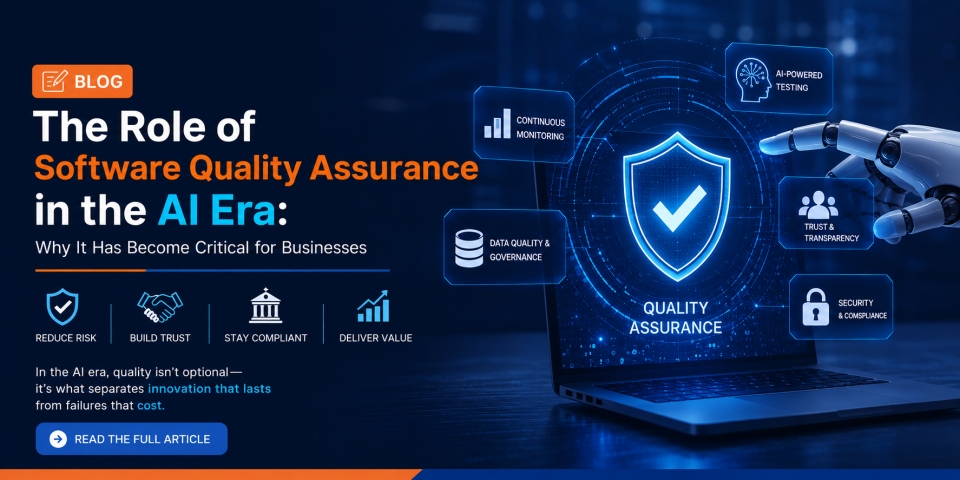
Yet this rapid adoption has exposed a fundamental truth: traditional approaches to software quality are no longer enough. Software Quality Assurance (SQA) has evolved from a supporting technical function into a strategic business imperative. In the AI era, rigorous quality assurance is what separates trustworthy, scalable AI systems from costly failures that damage reputation, trigger regulatory scrutiny, and erode customer trust.
The Shift: From Deterministic Code to Adaptive Intelligence
Classic software behaves deterministically. Given the same inputs, it produces the same outputs. Quality assurance focused on verifying that code matched requirements, catching bugs, and ensuring performance and security.
AI systems—especially those powered by machine learning and generative models—operate differently. They learn from data, exhibit probabilistic behavior, can drift over time as real-world conditions change, and often function as “black boxes.” Outputs may vary, hallucinations can occur, biases can emerge from training data, and models can degrade without continuous oversight.
These characteristics create new quality risks:
- Non-determinism and the “test oracle problem” (difficulty defining a single correct answer)
- Heavy dependence on data quality, representativeness, and governance
- Model drift, performance degradation, and unexpected behavior in production
- Bias, fairness, and ethical concerns
- Security vulnerabilities, including those introduced by AI-generated code
- Explainability and auditability challenges for regulated industries
At the same time, AI coding assistants and generative tools are dramatically accelerating development velocity. More code is being produced faster than ever—much of it AI-assisted—creating a growing “validation debt” where testing and verification struggle to keep pace.
Why Software Quality Assurance Is Critical in the AI Era
- Business Risk Has Escalated Dramatically
When traditional software fails, the impact is usually limited. When AI systems fail—especially those influencing decisions, customer interactions, or operational processes—the consequences cascade. A biased lending model can trigger regulatory investigations. A hallucinating chatbot can spark public backlash and customer churn. An unreliable recommendation or diagnostic system can cause financial loss or harm.
Surveys and industry reports consistently show rising production incidents linked to AI-generated code, with many organizations reporting increased defects, security issues, and operational disruptions. Poor software quality is no longer just an engineering problem; it has become a board-level concern affecting contracts, investor confidence, and brand reputation.
- Trust Is the New Currency
Customers, partners, and regulators expect AI systems to be reliable, fair, and transparent. Enterprise buyers increasingly demand documented AI governance and quality controls in RFPs. Investors conduct AI due diligence. Without robust assurance, even powerful AI capabilities fail to deliver lasting value because users and stakeholders do not trust them. - Regulatory and Compliance Pressure Is Rising
Regulations around AI (including emerging frameworks on transparency, bias, risk management, and accountability) require organizations to demonstrate that their systems meet defined quality and safety standards throughout the lifecycle. SQA provides the evidence, traceability, and continuous monitoring needed for compliance. - The Cost of Failure Is Higher—and Often Hidden
AI project failure rates remain high, with many initiatives stalling at the proof-of-concept stage or underdelivering in production. A significant portion of AI engineering spend can be lost to rework, bug fixes, and delayed deployments. Early and continuous quality practices reduce these costs and accelerate true time-to-value. - AI Is Both a Challenge and an Enabler for Quality
Ironically, while AI introduces new quality challenges, it also powers advanced quality engineering. AI-augmented testing can generate test cases, prioritize risks, perform self-healing automation, detect anomalies, and expand coverage. However, human judgment remains essential for evaluating business intent, usability, ethics, and complex edge cases. The winning approach is hybrid: AI accelerates and scales quality work, while humans provide strategic oversight and critical thinking.
The Evolving Role of SQA in the AI Era
Modern software quality assurance for AI-powered systems extends far beyond traditional functional testing. It encompasses:
- Data quality and governance — Ensuring training and operational data is accurate, representative, unbiased, and well-documented.
- Model validation and robustness testing — Assessing accuracy, performance under varied conditions, adversarial robustness, and resistance to drift.
- Fairness, bias, and ethical evaluations — Measuring disparate impact and ensuring equitable outcomes across user groups.
- Explainability and transparency checks — Supporting auditability and human understanding of decisions.
- Security and privacy testing specific to AI (including risks from AI-generated code).
- Continuous monitoring and feedback loops — Detecting performance drift, hallucinations, and emerging issues in production.
- Lifecycle risk management — Classifying AI use cases by risk and applying proportionate controls from requirements through deployment and ongoing operation.
- Human oversight mechanisms — Clear accountability and “human-in-the-loop” or “human-over-the-loop” processes.
SQA teams are shifting from pure “gatekeepers” to strategic partners who collaborate across product, engineering, data science, legal, compliance, and cybersecurity. Quality engineers increasingly act as verifiers and curators of quality—defining intent, interpreting results, and ensuring AI outputs align with business goals and ethical standards.
Building Effective AI Quality Practices
Leading organizations treat AI quality assurance as a cross-functional business capability rather than a late-stage technical activity. Key practices include:
- Embedding quality from the earliest stages (requirements validation, data preparation, and design).
- Establishing clear ownership and governance models that connect technical and business stakeholders.
- Combining automated AI-powered testing with targeted human expertise.
- Implementing continuous evaluation frameworks that evolve with the models.
- Investing in skills development so quality professionals understand AI/ML concepts, data issues, and emerging tools.
- Measuring success not only by defect counts but by trust metrics, risk reduction, compliance readiness, and business outcomes.
Conclusion: Quality as a Competitive Advantage
In the AI era, software quality assurance is no longer optional or secondary. It is the foundation that allows businesses to innovate rapidly while managing risk, building trust, and delivering reliable value. Companies that treat quality as a strategic function—integrating it across the AI lifecycle, leveraging AI to enhance testing itself, and maintaining strong human oversight—will be the ones that turn AI ambitions into sustainable success.
Those that prioritize speed alone risk accumulating technical and validation debt that eventually surfaces as failures, regulatory problems, or lost customer confidence. In a world where AI influences more decisions every day, the organizations that win will be those that ensure their intelligent systems are not only powerful, but also dependable, fair, and worthy of trust.
Quality assurance has always mattered. In the age of artificial intelligence, it has become mission-critical.