
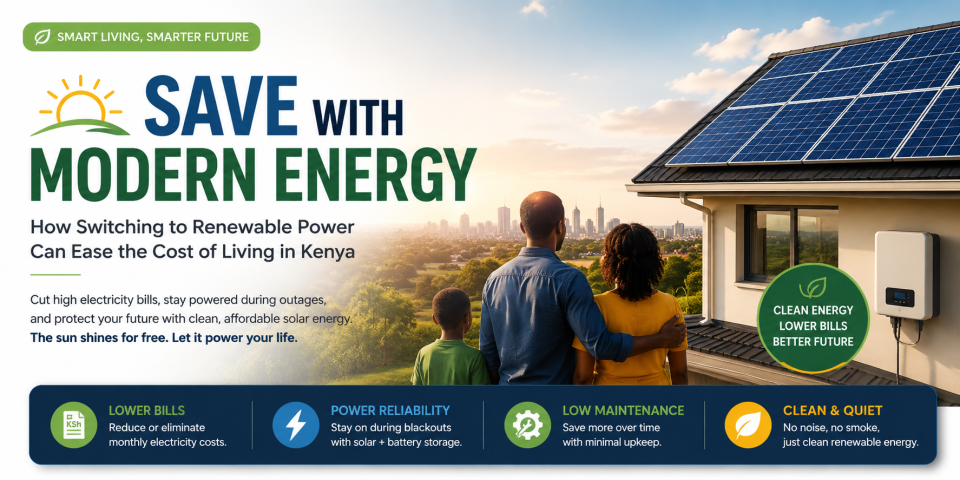
How Switching to Renewable Power Can Ease the Cost of Living in Kenya
Many of us find it harder these days to put money aside. In Kenya’s current economy, the cost of almost every basic need is climbing — water, food, education, shelter, and electricity all take a bigger bite out of the household budget than they used to. It’s easy to feel like saving is a luxury reserved for someone else. But there is at least one basic need where the cost is largely in our own hands: the power we use every day. The shift toward renewable energy, especially solar, is giving families, schools, and small businesses across the country a real way to cut expenses while still keeping the lights on.
The Rising Cost of Staying Powered
Electricity bills from the national grid keep climbing, and relying solely on a single power supplier comes with two costs: the money you pay every month, and the productivity you lose every time the power goes out. For a household, that might mean spoiled food or a sleepless, dark evening. For a business, it can mean lost sales, idle staff, and equipment left standing still. For a school, it can mean lessons interrupted and computer labs going quiet. Why keep absorbing that cost and that risk when a better option already exists?
Why Solar Makes Sense in Kenya
Kenya, and Africa more broadly, is blessed with strong, consistent sunshine almost all year round. That sunshine is free, and a solar panel is simply a tool for turning it into usable power for your house, school, or business. Once the system is installed, the fuel that runs it never sends you a bill. Over time, that free fuel is what turns an upfront investment into real, ongoing savings, because the cost of running your home stops being tied to a monthly bill that only moves in one direction: up.
How the Savings Add Up
The savings from going solar are not just theoretical. They show up in a few concrete ways:
- A smaller or disappearing electricity bill, since the sun is doing the work the grid used to do.
- Fewer losses from blackouts and outages, since a solar system with battery storage keeps running when the grid doesn’t.
- Lower long-term maintenance costs compared to running backup generators, which need fuel, servicing, and constant refilling.
- Protection from future price increases, since your main energy cost is paid once, not billed every month indefinitely.
A Cleaner, Quieter Way to Live
Beyond the money, solar power is simply kinder to the world around us. It produces no noise, unlike a generator rattling away in the background, and no smoke or emissions polluting the air we breathe. That means a healthier compound for your family, a quieter classroom for students, and a cleaner environment for the whole community. Choosing renewable energy is one of the simplest ways an ordinary household can reduce its environmental footprint without changing how it lives day to day.
Getting Started
Making the switch doesn’t have to happen all at once. A few practical steps can help:
- Start by looking at your current bill to understand how much power your home, school, or business actually uses.
- Talk to a reputable local solar provider about a system sized to that usage, rather than guessing.
- Consider starting small — lighting and a few essential appliances — and expanding the system over time as your budget allows.
- Ask about financing or pay-as-you-go solar plans, which are increasingly available in Kenya and can lower the barrier to getting started.
The Bottom Line
With the cost of living rising across Kenya, it makes sense to look for savings wherever they honestly exist. Renewable energy, and solar power in particular, is one of the clearest opportunities available: it uses a resource the country already has in abundance, it protects households and businesses from unreliable and increasingly expensive grid power, and it does all of this while leaving the environment cleaner. Using a solar panel isn’t just a trend — for many Kenyan families, it’s becoming the smartest way to keep the lights on and protect the wallet at the same time.