
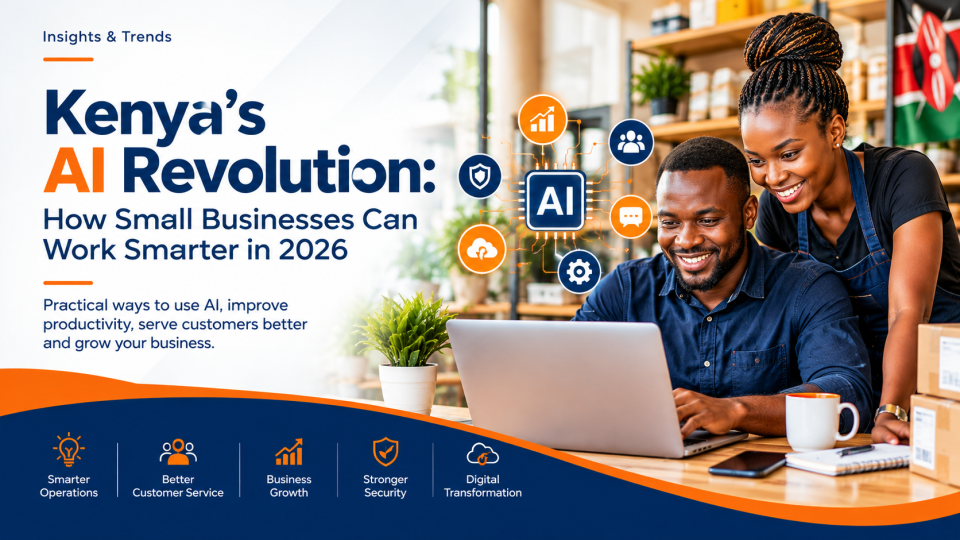
Artificial intelligence is creating new opportunities for Kenyan businesses. Here is how small and medium-sized enterprises can use it to improve productivity, serve customers better, and compete in a digital economy.
Introduction: A New Chapter for Kenyan Businesses
Kenya’s technology sector continues to evolve, creating new opportunities for entrepreneurs, startups, and established companies. From mobile payments and online shopping to cloud computing and business software, digital tools have steadily changed how organisations operate.
Now, artificial intelligence (AI) is opening another chapter.
Businesses can use AI to analyse information, prepare reports, respond to common customer questions, organise business processes, and generate ideas for marketing campaigns. Tasks that once consumed hours of manual work can, in some cases, be completed much faster with the right tools and human oversight.
However, the opportunity is not limited to large corporations or technology companies. A small shop in Nairobi, a professional services firm in Nakuru, a school in Kisumu, or a growing distributor in Mombasa can also explore practical applications of AI.
The real question is no longer whether AI deserves attention. It is how Kenyan businesses can use it responsibly to solve real problems.
1. AI Is Moving Beyond Experimentation
Many people first encounter AI through chatbots, image generators, or tools that help write and summarise content. These applications are useful starting points, but business value becomes clearer when AI supports everyday operations.
For example, a business can use AI to organise customer enquiries, draft product descriptions, summarise lengthy documents, or identify recurring questions raised by customers.
A sales team might use AI to prepare initial customer proposals. A marketing department could use it to develop campaign ideas and adapt content for different platforms. An operations manager could use AI-assisted analysis to identify patterns in sales reports.
Kenya’s growing AI ecosystem provides an important foundation for this change. Nevertheless, adopting a tool is not the same as transforming a business. Companies need clear objectives, suitable data, employee training, and processes for checking the accuracy of AI-generated results.
Businesses that focus on measurable improvements rather than the excitement surrounding new technology are more likely to gain lasting value.
2. Five Practical Ways Kenyan SMEs Can Use AI
Improve customer service
Customers increasingly expect businesses to respond quickly and provide clear information. AI-assisted customer service tools can help answer routine questions, guide customers to relevant services, and organise enquiries for follow-up.
A business could, for example, prepare a knowledge base covering its opening hours, prices, delivery policies, and frequently asked questions.
For more complex issues, customers should still have a clear route to a human representative. AI should improve the customer experience, not make it difficult to reach someone who can help.
Strengthen marketing and content creation
Maintaining a consistent online presence can be challenging for a small business with limited staff and resources.
AI can help marketing teams brainstorm campaign themes, create first drafts of social media posts, structure blog articles, and adapt messages for different audiences.
Human review remains essential. Businesses must verify claims, correct errors, preserve their brand voice, and ensure that published material reflects their actual products and services.
The strongest approach combines AI-assisted production with human creativity, local market knowledge, and a clear marketing strategy.
Automate repetitive administrative tasks
Routine administration can take valuable time away from activities that generate revenue.
Depending on the systems involved, businesses may automate parts of appointment scheduling, document classification, data entry, invoice processing, and report preparation.
For example, an organisation that receives many service requests could use a digital workflow to record each request, assign it to the appropriate team, and notify the customer when progress is made.
Not every task requires AI. Conventional automation may be more affordable, predictable, and easier to maintain for straightforward processes. The goal is to choose the simplest technology that solves the problem effectively.
Make better use of business data
Sales records, customer enquiries, stock reports, and expense summaries contain information that can support better decisions.
AI-assisted analytical tools can help identify patterns, highlight unusual changes, and summarise large amounts of information. A retailer might investigate which products sell most frequently, while a service company could review the types of enquiries it receives each month.
These insights are only as reliable as the information behind them. Incomplete records, inconsistent data, and misleading assumptions can produce poor recommendations.
Businesses should therefore maintain accurate records and verify important findings before making financial or operational decisions.
Support employees and continuous learning
AI can assist employees with research, internal documentation, training materials, and explanations of unfamiliar technical concepts.
A new employee could use an approved internal knowledge resource to understand a company procedure. A manager could prepare a first draft of a training guide for review by an experienced colleague.
AI should complement employee knowledge rather than replace professional judgement. Organisations should also train their teams to recognise errors, protect confidential information, and understand when a task requires specialist expertise.
3. Why Cybersecurity and Data Protection Matter
As businesses adopt more digital tools, they must also pay attention to security.
AI applications may process customer names, contact details, financial records, employee information, and confidential business documents. Uploading such information into an unapproved service can create privacy and security risks.
Kenya’s digital environment faces growing cybersecurity challenges. The Communications Authority’s reported figures for the 2025/2026 financial year indicate a substantial increase in detected cyber threats, reinforcing the importance of protecting digital systems.
Businesses can take practical steps to reduce exposure:
- Use strong, unique passwords and enable multi-factor authentication where available.
- Keep websites, operating systems, applications, and plugins updated.
- Back up important information and periodically test recovery procedures.
- Limit employee access to the information required for their roles.
- Train staff to recognise phishing messages, suspicious links, and impersonation attempts.
- Review the privacy and security practices of third-party digital services.
- Establish clear rules for entering company or customer information into AI tools.
Businesses operating in Kenya should also consider their obligations under the Data Protection Act, 2019, and applicable guidance. AI adoption does not remove the responsibility to handle personal data appropriately.
Security should be considered when selecting and implementing a technology solution, rather than added only after a problem occurs.
4. The Importance of Choosing the Right Technology
One of the common mistakes businesses make is purchasing software before identifying the problem they need to solve.
A company might invest in several applications but continue relying on spreadsheets, duplicated records, and manual communication because the tools do not work well together.
Before introducing a new solution, business owners should ask:
- Which process currently consumes the most time or resources?
- What specific improvement would make the biggest difference?
- Can the existing systems support the proposed solution?
- What information will the tool access, and how will that information be protected?
- How will the business measure success?
- Who will train employees and maintain the system?
The answers can help determine whether the right solution is AI software, a cloud platform, a customer relationship management system, a point-of-sale solution, custom software, or a simpler workflow improvement.
Technology should support the business strategy. It should not become an expense without a clear purpose.
5. A Practical Starting Plan for Kenyan SMEs
Businesses do not need to transform every department at once. A focused approach can reduce risk and make results easier to measure.
Step 1: Identify one business challenge. Choose a repetitive or time-consuming process, such as preparing reports, responding to common enquiries, or organising customer records.
Step 2: Establish a baseline. Record how much time the task takes, how often errors occur, and what it costs the business.
Step 3: Select an appropriate tool. Compare available options based on functionality, cost, ease of use, security, and compatibility with existing systems.
Step 4: Run a small pilot. Test the solution with a limited workflow and a responsible team before expanding its use.
Step 5: Review the results. Compare the pilot against the original baseline. Check whether the solution saves time, improves accuracy, or delivers a better customer experience.
Step 6: Improve and expand carefully. Address weaknesses, train employees, document procedures, and expand only when the results justify doing so.
This approach helps businesses make decisions based on evidence rather than assumptions.
6. The Human Factor Will Remain Important
Despite its capabilities, AI does not automatically understand every customer, business environment, or local challenge.
Kenyan businesses operate across different industries, languages, budgets, connectivity conditions, and customer expectations. A solution that works well for one organisation may not be suitable for another.
Human judgement remains necessary for interpreting results, resolving sensitive complaints, making strategic decisions, and building trust with customers.
Businesses should also be transparent about how automated systems are used where appropriate, provide a way to challenge important decisions, and ensure that employees understand their responsibilities.
The objective should be to combine the speed of digital tools with the experience, accountability, and creativity of people.
Conclusion: Turning Kenya’s AI Opportunity Into Business Results
Artificial intelligence offers Kenyan businesses new ways to improve productivity, understand their customers, and strengthen their digital operations. Yet long-term success will depend less on adopting the newest tool and more on choosing the right solution for a clearly defined need.
Small and medium-sized enterprises can begin with manageable projects, protect their information, train their teams, and measure the results before making larger investments.
As Kenya’s digital economy develops, businesses that combine practical innovation with strong security and sound decision-making will be better prepared to adapt.
At Favitech Solutions Ltd, we believe technology should do more than look impressive. It should solve problems, support growth, and create meaningful value for the people who use it.
Whether your business needs software development, website solutions, business automation, cloud services, or digital technology guidance, the right starting point is understanding your needs and building a solution around them.
Favitech Solutions Ltd — Transformative | Innovative | Reliable
Visit www.favitech.co.ke to explore technology solutions for your business.
