
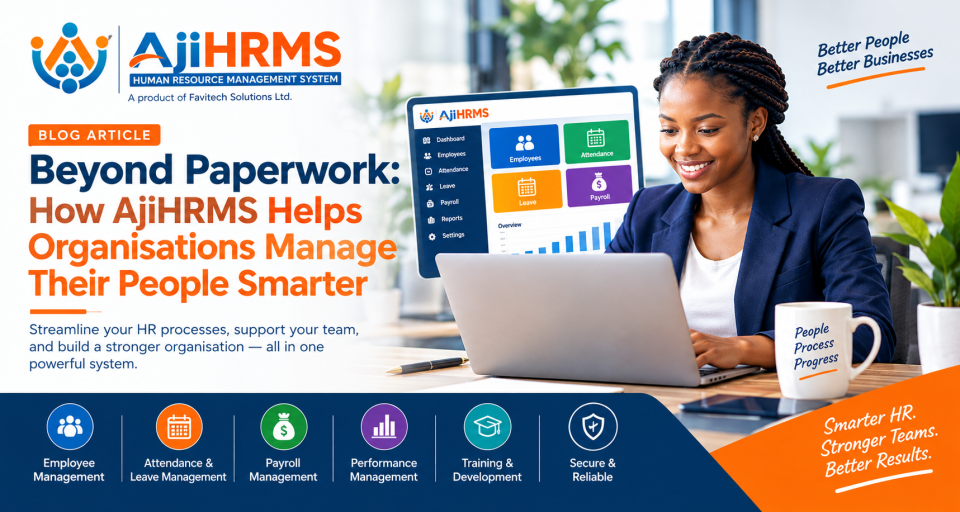
Human resource management is a critical part of every organisation. From recruiting new employees and maintaining personnel records to managing attendance, leave, payroll, and employee development, HR teams handle processes that directly influence business operations.
However, when these activities rely heavily on paperwork, spreadsheets, and disconnected systems, managing employees can become time-consuming and difficult to coordinate.
As organisations grow, the need for more organised, efficient, and technology-driven HR processes becomes increasingly important.
This is where AjiHRMS, a Human Resource Management System by Favitech Solutions Ltd., comes in.
What Is AjiHRMS?
AjiHRMS is a Human Resource Management System designed to help organisations manage essential human resource functions through a centralised digital platform.
The system brings together key HR modules, enabling organisations to organise personnel information, manage recruitment activities, coordinate workforce administration, and support employee performance and development.
Rather than treating each HR activity as an isolated task, AjiHRMS provides a structured environment for managing different aspects of the employee lifecycle.
For businesses seeking to improve how they manage their workforce, an integrated HR management system can be an important step towards more consistent and organised operations.
Why Traditional HR Management Can Be Challenging
Many organisations still depend on manual processes or multiple disconnected tools to manage their employees. While these approaches may work for smaller teams, they can become increasingly difficult to maintain as the workforce expands.
Common challenges include:
- Scattered employee records: Personnel information stored across different files and spreadsheets can be difficult to organise and retrieve.
- Time-consuming recruitment: Managing vacancies, applications, candidate screening, and interviews manually can create administrative pressure.
- Attendance and leave administration: Tracking employee attendance and leave requests without a structured process can complicate workforce planning.
- Payroll preparation: Maintaining accurate employee and payroll information requires organised records and careful administrative procedures.
- Limited performance visibility: Without a structured approach to performance management and training, it can be difficult to coordinate employee development.
- Administrative fragmentation: Switching between separate tools for different HR functions can make workflows harder to coordinate.
These challenges demonstrate why organisations need to evaluate how technology can support their HR processes.
Key AjiHRMS Features That Support Modern HR Management
AjiHRMS includes dedicated modules for several important areas of human resource administration.
1. Personnel Information Management (PIM)
Employee information forms the foundation of effective HR management. Organisations need a structured way to maintain and manage personnel records throughout the employee lifecycle.
The Personnel Information Management module provides a dedicated environment for organising employee information, supporting more systematic personnel administration.
2. Recruitment Management
Finding and hiring suitable employees requires coordination across several stages, from advertising vacancies to evaluating candidates and conducting interviews.
The Recruitment module supports the management of recruitment activities, helping organisations organise their hiring workflows and maintain a more structured approach to talent acquisition.
A well-managed recruitment process can help HR teams coordinate activities and improve visibility throughout the hiring journey.
3. Attendance Management
Understanding employee attendance is important for workforce coordination and operational planning.
The Attendance module provides a dedicated area for managing attendance-related activities, helping organisations incorporate attendance administration into their broader HR processes.
4. Leave Management
Employee leave requires clear processes for requests, reviews, approvals, and record-keeping.
AjiHRMS includes a Leave Management module to support the administration of employee leave within the HR environment.
Organised leave management can help businesses coordinate staffing requirements while maintaining clearer employee records.
5. Organisation Chart and Structure
As organisations grow, reporting relationships, departments, and responsibilities may become more complex.
AjiHRMS includes Organisation Chart and Organisation Structure modules to support the representation and management of organisational arrangements.
These capabilities can help HR teams maintain a clearer view of how an organisation is structured.
6. Employee Lifecycle Management
An employee’s journey involves more than recruitment and onboarding. It may include role changes, development, ongoing employment administration, and eventual separation.
The Employee Lifecycle module provides a dedicated area for managing employee-related processes across different stages of employment.
This supports a more coordinated approach to workforce administration.
7. Performance Management
Employee performance is an important consideration in organisational development.
The Performance Management module supports structured performance-related processes, helping organisations incorporate employee performance into their HR management activities.
When supported by clear objectives and consistent review practices, performance management can contribute to better alignment between employee responsibilities and organisational goals.
8. Training and Development
Continuous learning helps employees build skills and adapt to changing workplace requirements.
AjiHRMS includes a Training and Development module to support the coordination of employee learning and development activities.
Organisations can use structured training processes to support professional growth and workforce capability development.
9. Payroll Management
Payroll administration requires careful coordination of employee information and compensation-related records.
The Payroll Management module provides a dedicated area for managing payroll-related activities within the HR system.
Organisations should ensure that payroll workflows are properly configured and reviewed to support their applicable employment, tax, and statutory obligations.
10. Asset Management
Organisations often need to track equipment and other resources used by employees in their day-to-day work.
The Asset Management module extends AjiHRMS beyond personnel administration by providing a dedicated area for managing organisational assets.
This can support more organised oversight of resources used across the business.
How an Integrated HRMS Can Benefit Your Organisation
Implementing an HR management system is not simply about replacing paper records with digital ones. The broader objective is to establish better processes for managing people and coordinating HR activities.
Improved Organisation
Centralising key HR functions can help reduce fragmentation and provide a more structured environment for employee administration.
More Efficient Workflows
A digital HR platform can support the organisation of recurring activities, helping HR teams coordinate tasks more systematically.
Better Workforce Visibility
Dedicated modules for recruitment, attendance, leave, performance, and training can help organisations maintain clearer oversight of their HR activities.
Support for Organisational Growth
As a business expands, its HR requirements often become more complex. A structured HR management platform can provide a foundation for managing these growing responsibilities.
More Time for People-Focused Activities
When routine administration is better organised, HR professionals can devote more attention to employee engagement, development, workforce planning, and organisational culture.
The actual benefits depend on the system’s configuration, the processes adopted by the organisation, and how consistently the platform is used.
Who Can Benefit from AjiHRMS?
AjiHRMS may be relevant to organisations that want to bring their core HR functions into a more organised digital environment.
Potential users include:
- Small and medium-sized enterprises seeking to structure their HR operations.
- Growing businesses managing an expanding workforce.
- Established organisations coordinating multiple HR functions.
- HR departments looking to reduce reliance on disconnected records and tools.
- Organisations seeking a more integrated approach to recruitment, personnel administration, payroll, and employee development.
Before implementation, each organisation should assess its workforce size, existing processes, reporting requirements, and specific operational needs.
Choosing the Right Human Resource Management System
Before adopting an HRMS, businesses should consider several practical questions:
- Does the system support the HR functions the organisation needs?
- Can employee information be organised and accessed appropriately?
- Does the system support the organisation’s recruitment and workforce administration processes?
- Are access controls and data protection measures suitable for sensitive employee information?
- Can the system accommodate the organisation’s reporting and operational requirements?
- What training and implementation support will employees and administrators require?
These considerations help ensure that technology supports real business needs rather than introducing another disconnected administrative tool.
Organisations should also assess applicable data protection obligations, particularly when processing sensitive employee information.
The Future of HR Is More Organised and Technology-Driven
Human resource management continues to evolve as businesses seek better ways to coordinate employees, maintain records, support professional development, and improve operational efficiency.
Technology cannot replace sound HR policies, effective leadership, or meaningful employee relationships. However, the right digital tools can help organisations establish more consistent processes and manage their workforce responsibilities more systematically.
AjiHRMS by Favitech Solutions Ltd. brings together dedicated modules for personnel information, recruitment, attendance, leave, organisational structure, employee lifecycle, performance management, training and development, payroll, and asset management.
For organisations looking to rethink how they manage their people, it offers an opportunity to explore a more integrated approach to HR administration.
Ready to Rethink Your HR Processes?
Are you still relying on paperwork, spreadsheets, or disconnected tools to manage your employees?
Explore how AjiHRMS could support your organisation’s human resource management needs.
Contact Favitech Solutions Ltd.
- Website: https://favitech.co.ke
- Email: info@favitech.co.ke
- Phone: 0701 821 252 / 0752 529 050
- Office: Jeevan Bharati House, Office Suite 604, Harambee Avenue, Nairobi, Kenya.
AjiHRMS — Smarter HR. Stronger Teams. Better Results.
Contact Favitech Solutions Ltd. to discuss your HR management requirements and explore the AjiHRMS platform.
