
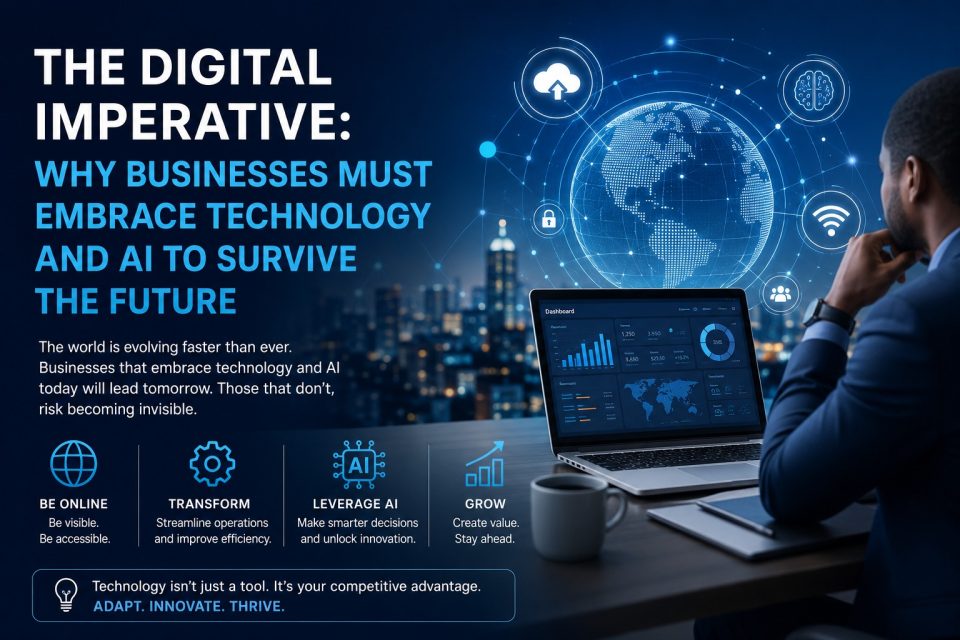
The business world has changed more in the last decade than it did in the previous fifty years.
Customers no longer discover businesses through newspapers, flyers, or word of mouth alone. They search online, compare options digitally, read reviews, interact through social media, and increasingly rely on AI-powered tools to make purchasing decisions.
Today, a business can lose customers without ever knowing it simply because it cannot be found online.
The reality is becoming clearer every year:
Businesses that fail to embrace technology are not merely falling behind—they are becoming invisible.
The Internet Is No Longer Optional
There was a time when having a website was considered a luxury. Today, it is a necessity.
When potential customers need a product or service, their first instinct is to search online. If your business cannot be found, customers often assume it does not exist, is unreliable, or is no longer active.
A digital presence is no longer about prestige; it is about accessibility.
Modern businesses need:
- A professional website
- Social media presence
- Online customer support channels
- Digital payment capabilities
- Search engine visibility
- Mobile-friendly experiences
Customers expect convenience. Businesses that fail to provide it create opportunities for competitors that do.
Digital Transformation Is About More Than Technology
Many organizations mistakenly believe digital transformation means buying software or creating a website.
True digital transformation involves rethinking how a business operates, serves customers, and creates value using technology.
It means:
- Automating repetitive processes
- Digitizing records and workflows
- Improving communication and collaboration
- Using data to make informed decisions
- Enhancing customer experiences
Technology should not merely support business operations—it should become a strategic driver of growth.
Organizations that embrace digital transformation often experience improved efficiency, better customer engagement, and greater adaptability in changing markets.
The Rise of Artificial Intelligence
If the internet transformed how businesses connect with customers, Artificial Intelligence (AI) is transforming how businesses operate.
AI is no longer reserved for large technology companies. It is becoming accessible to businesses of all sizes.
Today, AI can help organizations:
- Analyze customer behavior
- Automate customer support
- Generate business insights
- Predict market trends
- Improve operational efficiency
- Enhance decision-making
- Personalize customer experiences
Businesses that effectively integrate AI are gaining significant advantages in speed, efficiency, and innovation. Research continues to show that AI strengthens operational performance and enables smarter, real-time decision-making.
The New Competitive Advantage
For years, businesses competed primarily on price, location, or product quality.
Today, a new factor has emerged:
Digital capability.
The businesses winning in modern markets are those that can:
- Reach customers online
- Respond quickly
- Analyze data effectively
- Automate routine processes
- Leverage AI intelligently
- Continuously innovate
The question is no longer whether technology matters.
The question is:
How quickly can your organization adapt?
The Cost of Standing Still
Many businesses delay technology adoption because they fear the cost of change.
Ironically, the greater risk is the cost of doing nothing.
Organizations that resist digital transformation often face:
- Reduced visibility
- Slower operations
- Poor customer experiences
- Limited scalability
- Higher operational costs
- Increased competitive pressure
History repeatedly shows that industries are disrupted not by the largest organizations but by the most adaptable ones.
Technology rewards innovation and punishes complacency.
What Businesses Should Do Today
Every organization, regardless of size, should begin by asking:
- Can customers easily find us online?
- Are our operations still heavily manual?
- Are we using data to make decisions?
- Are we leveraging automation where possible?
- How can AI improve our efficiency and customer experience?
The answers to these questions often reveal opportunities for growth and transformation.
Conclusion
We are entering an era where technology is no longer a supporting function—it is becoming the foundation upon which successful businesses are built.
The internet has changed how customers discover businesses.
Digital transformation has changed how businesses operate.
Artificial Intelligence is changing how businesses think and make decisions.
Organizations that embrace these shifts will unlock new opportunities for growth, innovation, and resilience.
Those that ignore them risk becoming increasingly irrelevant in a world that is moving faster than ever before.
The future belongs to businesses that are connected, digital, intelligent, and ready to evolve.