
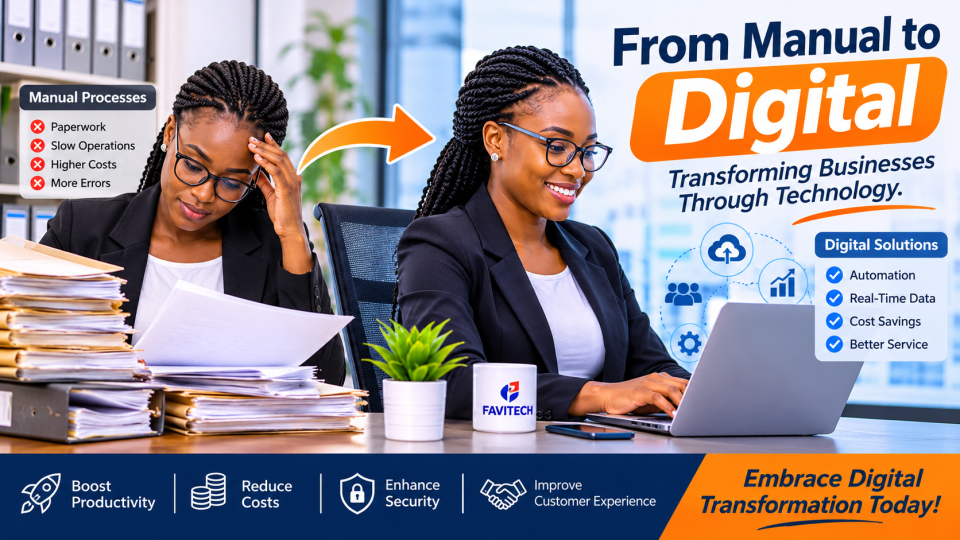
Embracing Digital Transformation for a Smarter, Faster and More Efficient Future
The world is changing, and the way businesses operate must change with it. For decades, organizations have relied on manual processes to manage daily operations, store information, communicate with customers, process transactions and make important business decisions. While these traditional methods once served their purpose, the demands of today’s business environment require something faster, smarter and more reliable.
Welcome to the era of digital transformation.
Digital transformation is no longer a luxury reserved for large corporations. It has become an essential step for businesses of all sizes seeking to improve efficiency, reduce operational costs, enhance customer experiences and remain competitive in an increasingly digital economy.
1. Understanding the Shift from Manual to Digital
Imagine a business that still records sales in handwritten books, stores customer information in physical files, prepares payroll manually and tracks inventory using spreadsheets or paper records.
Now imagine another business that manages all these activities through integrated digital systems.
The difference is significant.
A digital business can generate reports within seconds, monitor stock levels in real time, process payments electronically, manage employees through HR software and access important information from virtually anywhere.
This is the transformation from manual operations to digital efficiency.
It involves adopting technology to simplify processes, eliminate unnecessary paperwork, improve accuracy and create better ways of delivering products and services.
2. Why Businesses Need to Move from Manual to Digital
Continuing to rely entirely on manual processes can limit business growth. As organizations expand, traditional methods become increasingly difficult to manage.
Here are some reasons why digital transformation matters:
Improved Efficiency and Productivity
Manual processes consume valuable time. Tasks such as preparing reports, calculating salaries, tracking inventory and managing customer records can take hours or even days.
Digital systems automate repetitive activities, allowing employees to concentrate on more productive and strategic responsibilities.
Reduced Operational Costs
Printing documents, maintaining physical records, handling paperwork and correcting manual errors all come with costs.
Digital solutions reduce unnecessary expenses while improving resource utilization.
Better Data Accuracy and Security
Human errors are common in manual recordkeeping. Incorrect calculations, misplaced documents and duplicated entries can affect business operations.
Digital platforms provide structured data management, controlled access, automated backups and improved record accuracy.
Faster and Smarter Decision-Making
Businesses need accurate information to make informed decisions.
Digital systems provide real-time reports, dashboards and analytics that help management understand performance, identify challenges and plan for growth.
Enhanced Customer Experience
Today’s customers expect convenience, speed and reliability.
From online shopping and digital payments to automated customer support, technology enables businesses to serve customers more effectively.
3. Areas Where Businesses Can Replace Manual Processes with Digital Solutions
Digital transformation can happen across virtually every department of an organization.
Accounting and Finance
Instead of maintaining handwritten financial records and manually calculating transactions, businesses can adopt accounting software to manage expenses, invoices, payments, financial statements and tax records.
Human Resource Management
Traditional employee files, attendance registers and manual payroll calculations can be replaced with Human Resource Management Systems (HRMS).
These systems simplify recruitment, employee records, leave management, attendance tracking, payroll processing and performance management.
Inventory and Sales Management
Businesses can move away from handwritten stock books and manual sales records by implementing Point of Sale (POS) and inventory management systems.
Such platforms help monitor stock movement, track sales, manage suppliers and generate accurate business reports.
Document Management
Physical filing cabinets can be replaced with Digital Document Management Systems (DMS), allowing organizations to store, organize, retrieve and share documents electronically.
Communication and Collaboration
Businesses can adopt digital communication and collaboration platforms to improve teamwork, manage projects, share information and coordinate activities across different locations.
Marketing and Customer Engagement
Traditional marketing methods can be complemented by websites, social media, email marketing, digital advertising and Customer Relationship Management (CRM) systems.
These tools help businesses reach wider audiences and build stronger customer relationships.
4. The Cost of Remaining Manual in a Digital Economy
One of the biggest misconceptions among small and medium-sized businesses is that digital transformation is expensive.
However, the real question should be: What is it costing your business to remain manual?
Consider the time spent searching for misplaced documents, correcting accounting errors, preparing reports, following up on payments and managing employee records.
These activities create hidden operational costs.
A business that spends several hours preparing a report manually could generate the same report in seconds using an appropriate digital system.
Similarly, an organization that struggles to track inventory manually could experience unnecessary stock losses, delayed orders and dissatisfied customers.
The cost of inefficiency can eventually become greater than the cost of adopting technology.
5. How to Begin Your Digital Transformation Journey
Digital transformation does not mean changing everything overnight. Businesses can start with manageable steps and gradually build a fully connected digital environment.
Here is a practical approach:
- Assess Your Current Operations: Identify processes that consume too much time, involve repetitive paperwork or frequently produce errors.
- Identify the Right Digital Solutions: Research software and technology that address your organization’s actual operational challenges.
- Start with Priority Departments: Begin with areas such as accounting, HR, inventory, sales or document management.
- Train Your Employees: Ensure that your team understands how to use the new systems effectively.
- Integrate Your Systems: Where possible, connect different business applications to minimize duplicated work and improve information flow.
- Monitor and Improve: Evaluate performance, collect feedback and continuously improve your digital processes.
The goal is not simply to acquire technology. It is to use technology to achieve measurable business improvements.
6. The Future Belongs to Digitally Empowered Businesses
Emerging technologies such as Artificial Intelligence (AI), cloud computing, automation, data analytics and the Internet of Things (IoT) are creating new opportunities for organizations.
Businesses can now automate routine activities, access information remotely, understand customer behaviour and make decisions based on actionable data.
In Kenya, where digital payments, mobile technology and online business platforms continue to influence the commercial environment, organizations that embrace digital solutions are better positioned to adapt to changing customer expectations and market demands.
The transition from manual to digital is therefore not just about replacing paper with computers. It is about building smarter organizations that can innovate, compete and grow sustainably.
Conclusion: Your Digital Transformation Starts Today
The transition from manual to digital is one of the most important investments a modern business can make.
Whether you operate a small business, an educational institution, an established company or a growing enterprise, technology can help you simplify operations, improve productivity and unlock new opportunities.
You do not have to transform everything at once. Start by identifying one manual process that slows your organization down, find the right digital solution and take the first step.
Stop doing tomorrow’s work with yesterday’s methods. Embrace digital transformation and build a smarter future for your business.
Technology is not just changing how businesses work. It is changing what businesses can achieve.
